
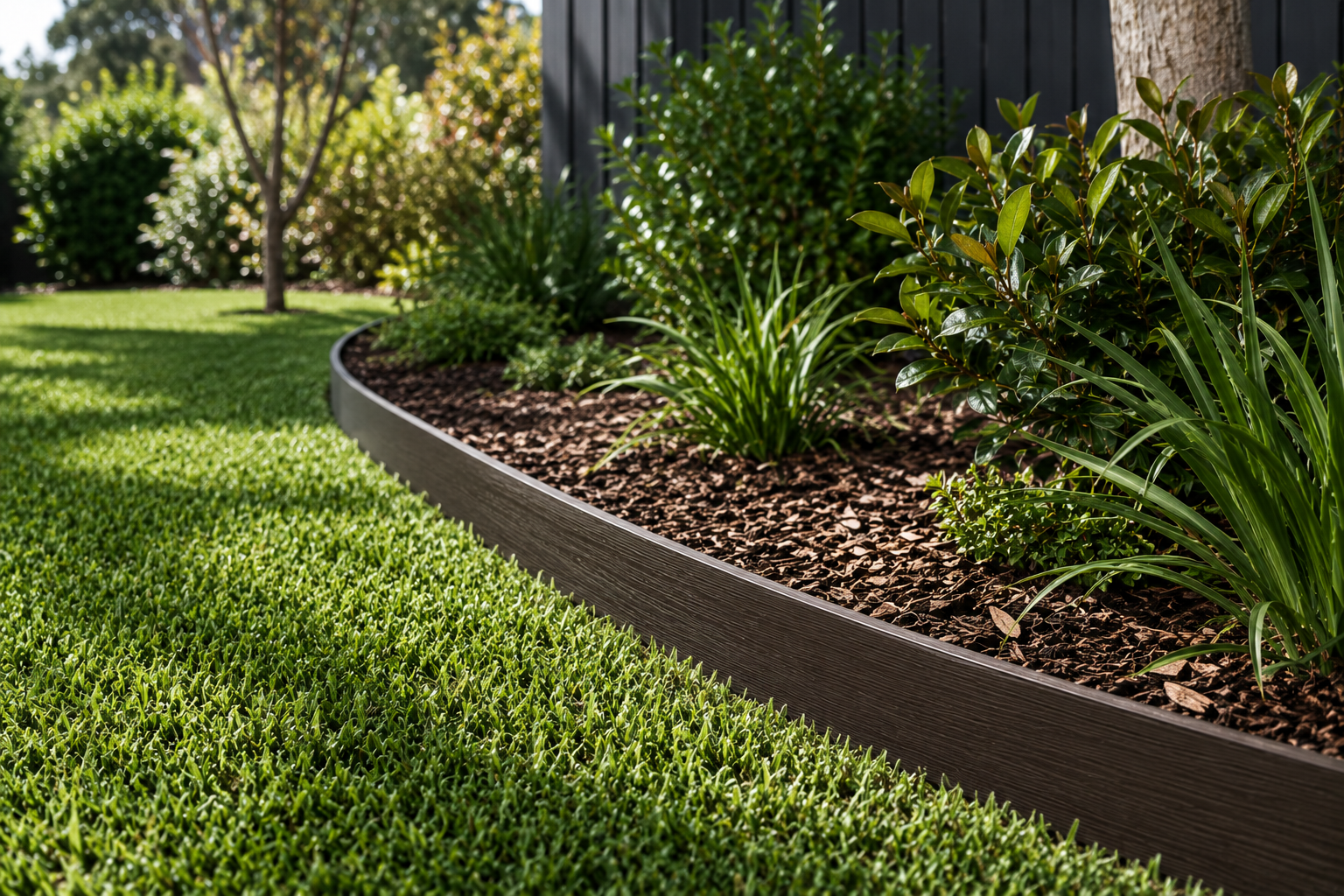
Composite Wood Garden Edging
The natural appearance of timber, engineered for life in the landscape.
Timber appearance. Different material.
Composite wood garden edging provides the warm, natural appearance associated with timber in a material designed specifically for outdoor landscapes. It creates a defined edge between lawns, planting, paths and other garden surfaces.
Hedge Eco Edge is made from composite wood and extruded to our edging profile, combining a timber-inspired finish with a consistent shape designed to make landscape installation simple and precise.
Natural timber can change as it is repeatedly exposed to moisture. Composite wood provides a timber alternative for the landscape without the same tendency to rot, warp or twist.
Designed around the garden.
Composite wood edging works naturally through residential gardens, creating defined boundaries between lawns, planting, pathways, gravel and other landscaped surfaces.
Eco Edge is particularly suited to applications where timber edging might traditionally be considered, bringing a warmer material appearance to the landscape while maintaining a clean, consistent garden edge.
Use Eco Edge to define lawns, garden beds, planting zones, paths and other landscape boundaries where you want the softer appearance of timber without using natural timber edging.
Create a clean natural boundary.
Composite wood edging creates a softer transition between lawn and planting while still giving the landscape a clearly defined edge. The timber-inspired finish sits naturally beside turf, mulch and planting without making the boundary feel overly engineered.
Eco Edge can be used to hold the line between lawn and garden bed, helping maintain a consistent shape through straight runs and curves while giving the finished landscape a warmer material character.
Keep the lawn meeting the edge cleanly with no unnecessary gap. On the garden side, allow mulch or soil to finish slightly below the top so the edge remains visible, neat and easy to maintain.
Connect the edge to the landscape.
Garden edging often sits between more than lawn and planting. Eco Edge can define the transition between garden beds, gravel, pathways and other landscaped surfaces while bringing the warmer appearance of composite wood into the detail.
Keeping the edging aligned with nearby paths and established landscape lines helps each surface connect cleanly. The result is a defined boundary that feels considered as part of the wider garden.
Use nearby paving, paths and other landscape elements to guide the set-out. Where different materials meet, keep the transition simple and allow the Eco Edge profile to create one continuous line between them.
Keep the detail precise.
Straight garden edges bring order to the landscape. They can align with paving, architecture, lawns and planting beds to create strong, intentional lines throughout the garden.
With Eco Edge, careful set-out helps the composite wood profile read as one continuous detail. Keeping each length aligned through the run creates a clean finish while allowing the timber-inspired surface to bring warmth to the landscape.
Establish long straight runs with a string line before fixing the edging. Check the alignment as each length is installed rather than correcting the line at the end.
Let the landscape flow.
Garden edges do not always need to follow straight lines. Curves can soften the transition between lawns, planting and pathways, allowing the shape of the edge to respond naturally to the landscape.
Eco Edge can be used to create flowing garden boundaries where a softer form is preferred. Keeping the radius smooth and continuous helps the composite wood profile read as one considered line through the garden.
Set out the complete curve before fixing the edging. Use broad, continuous radii where possible and avoid a series of small, irregular changes that can make the finished line appear uneven.
Designed to handle moisture differently.
Timber has long been used for garden edging because its natural appearance works easily within the landscape. But outdoors, timber is continually exposed to soil, irrigation, rain and changing moisture levels.
Eco Edge uses composite wood instead of natural timber, giving the landscape a timber-inspired appearance without relying on a material that can rot, warp or twist as moisture conditions change.
Garden edging spends its life close to the ground, where contact with moisture is unavoidable. Choosing composite wood provides an alternative where the appearance of timber is wanted without using natural timber for the edge itself.
A simple connected system.
Eco Edge is designed around the Hedge installation system, with dedicated straight and corner joiners helping individual lengths connect into one continuous landscape edge.
Set out the line first, position the edging to the required finished level, then connect and secure each length as the installation progresses. Working progressively helps keep straight runs aligned and curves smooth from beginning to end.
Establish the complete shape and finished level before final fixing. Check each connection as you work so adjoining lengths remain aligned and the finished Eco Edge reads as one continuous detail.
Let the material become part of the garden.
The final result depends on how the edging meets the landscape around it. Keep the top line consistent, make joins and corners clean, and finish lawn, mulch, soil and adjoining surfaces neatly against the Eco Edge profile.
When the set-out, finished levels and surrounding materials are resolved together, the composite wood edge becomes part of the overall garden rather than a detail that feels added afterwards.
View the completed edge from the main approaches through the garden. Check that straight runs, curves, joins and finished levels create one continuous line and that the composite wood finish sits naturally within the surrounding landscape.
Natural look. Hedge precision.
Explore Eco Edge composite wood garden edging, components and installation details, then choose the right solution for your landscape.